
Instructional Leadership Teams (ILTs)
TABLE OF CONTENTS
Welcome to our ILT guide! Use the buttons below to navigate the five-step framework for effective ILTs. As you scroll, you can use the hamburger menu on the left side of your screen to navigate this guide. This research was made possible with support from the Barr Foundation.
.png?width=300&name=New%20Report%20(1).png)
THE FIVE STEPS OF EFFECTIVE ILTS
Our research identified these five steps of effective ILTs:
.png?width=720&height=400&name=Set%20a%20small%20number%20of%20high-leverage%20instructional%20priorities%20(2).png)
Step 1: Set a small number of high-leverage instructional priorities
Identify one to two instructional priorities anchored in student learning evidence and protect them long enough to drive aligned walkthroughs, coaching, and professional learning across the system.
Step 2: Build leadership capacity
Develop the instructional knowledge and credibility of central office leaders, principals, and teacher-leaders. Give practitioners at every level the time, role clarity, and structured opportunities to observe, coach, and model the instruction they are asking others to improve.
Step 3: Design a coherent operating cycle
Connect inquiry, decision-making, support, monitoring, and learning into a recurring sequence that runs from the district to the classroom and back again.
Step 4: Connect district to classroom
Establish common expectations for school-based ILTs (i.e. focus, artifacts, and cadence), while preserving the flexibility that allows schools to own the work.
Step 5: Monitor progress
Use evidence from school-based ILTs to refine district strategy, adjust support where it is needed most, and return to the work with greater precision each cycle.
ILTS IN DIFFERENT CONTEXTS
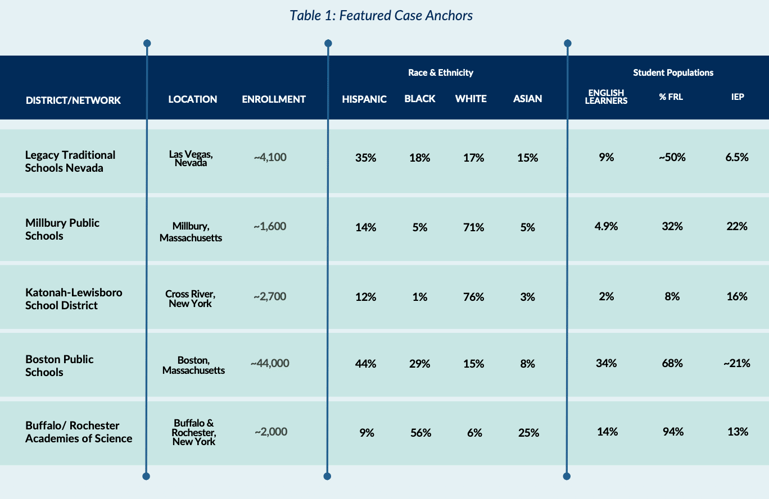
We conducted in-depth interviews with 20 leaders across twelve school systems representing a range of sizes, governance structures, and student demographics. Five systems are featured as case anchors: Millbury Public Schools, Legacy Traditional Schools (Nevada), Katonah-Lewisboro School District, Buffalo/Rochester Academies of Science, and two Boston Public Schools elementary schools: Thomas J. Kenny K-6 and Henry Grew (See Table 1 for district characteristics).
WHAT IS AN INSTRUCTIONAL LEADERSHIP TEAM?
The purpose of an instructional leadership team (ILT) is to improve the quality of teaching and learning across a school or system. They collaboratively create the conditions for accelerating student outcomes by setting and protecting instructional priorities, analyzing evidence from classrooms, aligning professional development from cabinet to classroom, and making decisions that change teacher practice and the student learning experience. Because the ILT leads instruction and professional development, it is also the natural home for equity work. Teams can analyze data, identify gaps in access and outcomes, and ensure that instructional programming is aligned to the needs of every student, particularly those who have been historically underserved.
Do ILTs only exist at the school level?
ILTs exist at two levels. A school-based ILT is the primary mechanism through which a school's instructional priority becomes visible in classrooms—translating district direction into teacher-facing support, coaching cycles, and evidence review.
However, a common misconception is that instructional leadership teams are primarily a school-level structure. The evidence from this research tells a different story. Across every system we studied, the most effective ILTs were expressions of what the district or network had already built: a clear instructional vision, a small number of shared priorities, aligned professional learning, and data-focused routines that connected what was happening in classrooms to what leaders were deciding in meetings. Where those conditions were in place, school-based ILTs became genuinely influential. Where they were still developing, meetings happened, but instructional practices didn't reliably change.
What is a District Instructional Leadership Team (ILT)?
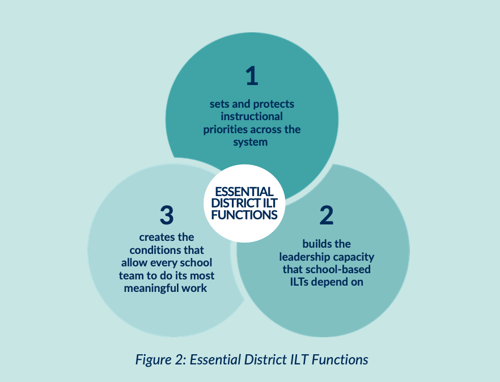
A district ILT serves three essential functions that no school-based team can fully provide on its own: it sets and protects instructional priorities across the system; it builds the leadership capacity that school-based ILTs depend on; and it creates the conditions that allow every school team to do its most meaningful work (see Figure 2).
Systems that narrowed their focus and held it steady, resisting the pull of new initiatives and competing mandates, saw stronger, more consistent instructional improvement than those that shifted frequently. The district ILT is the structure that owns that focus, protects it over time, and ensures it shows up consistently in walkthrough tools, coaching cycles, and professional learning as a living reference point. Developing leaders as instructional practitioners is equally central to the district ILT's purpose and a precondition for effective ILT work at any level. For example, Legacy Traditional Schools in Nevada invested in a full week of immersive development before the school year began, front-loading principals and APs with shared expectations and a calibrated understanding of its instructional framework.
When a district ILT fulfills both of those functions well, it creates the conditions for school-based ILTs to do their most meaningful work. That means protecting time, ensuring data flows in ways that are useful rather than burdensome, and learning from schools in return — using evidence to understand where support is landing and where it needs to change. And when the district learns from schools in return, that orientation, leaders as learners first, is precisely what school-based ILTs depend on.
What are ways District ILTs can fall short of their purpose?
A district ILT can fall short of that purpose in two distinct ways. The first is becoming a compliance and reporting team. In this case, information moves upward, updates are shared, and the meeting ends without any change in anyone's leadership or instructional practice. The second is over-direction: over-specifying implementation in ways that produce compliance rather than ownership. The district ILT's job is to hold the tension between coherence and autonomy: tight enough to keep schools aligned, loose enough to let them respond to their own students, staff, and stage of development.
The five-step framework below is synthesized from the trends that surfaced as we learned how the systems in our case study built and protected conditions to effectively navigate the tension between coherence and autonomy. These steps are not a checklist. They are a practical framework that positions the district ILT as the engine of instructional coherence and the school-based ILT as the place where that coherence becomes visible in classrooms.
THE FIVE-STEP FRAMEWORK FOR BUILDING AN EFFECTIVE DISTRICT ILT
Foundation: Define the Instructional Vision
Effective ILT work starts with a clear, shared instructional vision, one specific enough to drive decisions and coherent enough to unify practice across schools. Without it, priorities drift, walkthroughs measure the wrong things, and professional development loses its thread. This vision is not one of the five steps; it is the precondition for all of them. It names what strong instruction looks and sounds like, and it establishes what the district owns versus where schools may adapt. Systems that struggled to focus their ILTs almost always had an underlying clarity problem: a vision too broad to drive practice, or expectations that hadn't been translated into a shared understanding of what strong instruction actually looked like.
Examples of standardizing instructional expectations across buildings
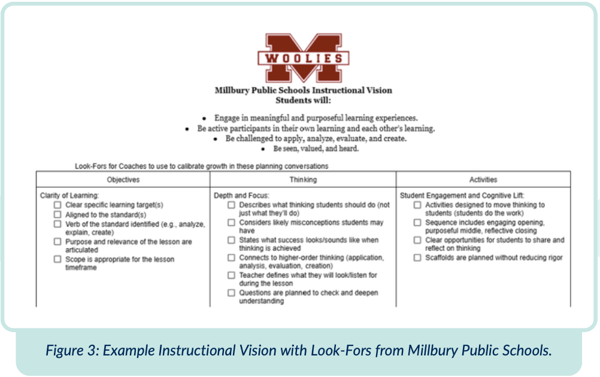
In Millbury, leaders codified instructional expectations with explicit look-fors and invested in calibration to ensure leaders across all buildings were seeing and naming the same things.
Buffalo/Rochester Academies of Science made decision rights concrete through a set of academic non-negotiables held firm across every campus, while giving principals flexibility in scheduling and teachers room to adapt up to 30% of any lesson.

Once that foundation is in place, the five steps that follow become possible.
Step 1: Set a small number of high-leverage instructional priorities
Narrow focus was among the clearest markers of high-performing ILTs across every system we studied. The strongest district ILTs identified one to two instructional priorities tight enough to drive aligned walkthroughs, coaching, and professional learning and substantive enough to sustain a full year of work. Naming a priority is only the beginning; protecting it against the constant pressure to add, respond, and shift is the ongoing work of leadership.
Naming a priority is only the beginning; protecting it against the constant pressure to add, respond, and shift is the ongoing work of leadership.
Nowell Academy (Rhode Island), whose leaders we interviewed, illustrates what that focus looks like when it takes hold. After noticing in the spring that collaborative structures were in place but students weren't doing the cognitive work, the ILT dug deeper and found that students were not generating new ideas or taking on the intellectual lift of the learning. That single observation became the foundation for a summer PD arc built around student-to-student collaboration, a revised walkthrough tool designed to look for it, and coaching cycles oriented toward it throughout the year.
As Executive Director of Nowell Academy, Jess Waters, described it, the goal is for the instructional focus to be "narrow enough but robust enough for an arc of PD" and something every teacher, regardless of experience level, has a place in. In The School District of University City (Missouri), another school whose leaders we interviewed, Superintendent Sharonica Hardin-Bartley takes a similarly deliberate approach, building learning strands at the end of each year based on PD feedback, teacher observations, and staff input, setting a clear direction in advance of the upcoming school year so the system is not constantly mid-course correcting.
In Millbury, the district ILT landed on "planning for thinking" as their instructional priority, a focus on designing learning experiences that required students to do the cognitive work. That single priority became the organizing thread for three full days of districtwide PD, a common walkthrough tool used across all three buildings, and PLCs facilitated by coaches and administrators.
The result was a coherence that had been elusive before the priority was named and held. As Chris Lowe, principal of the Millbury Junior/Senior HS described it, "You can go to any of our spaces and hear the same language."
Step 2: Build leadership capacity
What determines the quality of an ILT?
The quality of an ILT is ultimately a function of the quality of the leaders in the room at every level. That means investing in central office leaders, principals, and teacher-leaders alike, developing their knowledge and skills to lead instructional work as practitioners, not just managers. When central office leaders bring deep instructional knowledge to their roles, they can lead ILTs as genuine learning partners: asking questions, engaging with evidence, and modeling the same growth orientation they expect of schools.
The most effective systems treat central office development as ongoing, structural, and directly tied to the instructional priorities the district is asking schools to pursue.
In Katonah-Lewisboro, Superintendent Blanch built a District Guiding Coalition that includes building leaders, union representatives, and curriculum staff with the explicit charge of developing conditions for collaborative learning across the system. In University City, building leaders come together monthly through the Transformational Leadership Institute, leaving each session equipped to bring that work directly back to their schools.
Principals must be equally developed as instructional practitioners. Research is clear that the most effective school leaders focus their time and energy on improving instruction, yet studies consistently find principals spend less than 10% of their time on instructional activities. Closing that gap requires deliberate investment: principals who can observe with precision, give meaningful feedback, and model the learning orientation they ask of their teachers. In Millbury, coaches and administrators are deliberately developed side by side: "running PD together, conducting walkthroughs together, and speaking the same language, " as Lizz Boutiette described it. In University City, principals independently engage in the morning session of every TLI; in the afternoon, their full school leadership teams join them, strengthening leadership at every level simultaneously.
Teacher-leaders complete the bench. When teachers are actively involved in shaping priorities and given the time and role clarity to lead, they generate the kind of buy-in and collective ownership that makes change durable. In Nowell Academy, teacher-leaders modeled practice for colleagues and served as the communication bridge between the ILT and the departments they led. In Katonah-Lewisboro, collegial visitations created peer-driven momentum that formal PD alone could not. LTS Nevada front-loaded this investment by taking all principals and APs off-site for a full week before school began, immersing them in shared expectations, the instructional framework, and the tools and structures they would use all year. That single investment paid dividends across the entire operating cycle that followed.
Step 3: Design a coherent operating cycle
Clarity and strong leaders are necessary but not sufficient. What brings them to life is a consistent operating rhythm that moves from evidence to decision to support to monitoring and back to learning.
What is the ILT operating cycle?
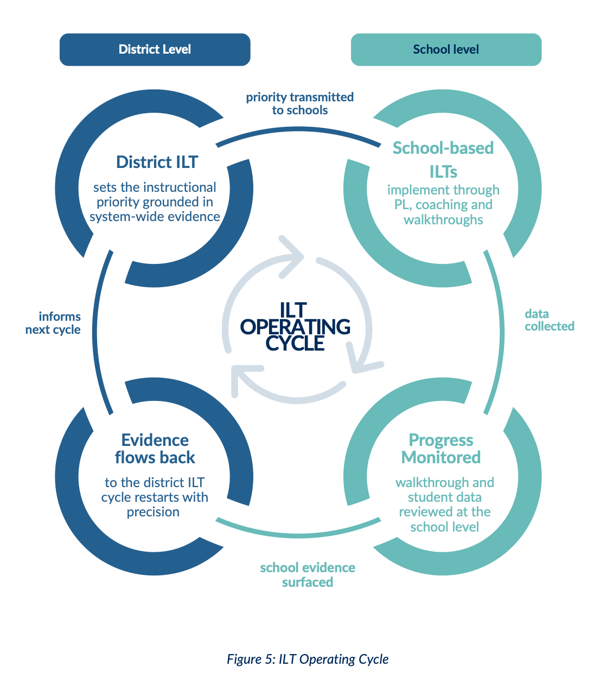
The ILT operating cycle is a structured loop (see Figure 5). The district ILT sets the instructional priority. That priority is rolled out to school-based ILTs through aligned professional learning, coaching, and walkthrough tools. Implementation is progress monitored at the school level, and evidence flows back to the district ILT, informing what happens next and restarting the cycle with greater precision. When that rhythm is in place, every meeting has a through-line, every conversation connects to classrooms, and the ILT becomes a genuine engine of instructional improvement.
Example of district/school ILT operating cycle
In Millbury, the cycle is embedded in the meeting architecture: a monthly district ILT feeds into coordinated school ILT meetings, department meetings, and PLCs. As Lizz Boutiette put it: "Everything at the schools is under the umbrella of the work we are doing at the district level." In LTSNevada, the cycle ran at multiple levels simultaneously — weekly campus visits, monthly principal convenings, and quarterly full-network step-backs. Whatever the cadence, the design principle is the same: the parts of the cycle must connect, and the loop must close.
“Everything at the schools is under the umbrella of the work we are doing at the district level." - Lizz Boutiette, Director of Teaching & Learning, Millbury Public Schools
Step 4: Connect District to Classroom
A coherent operating cycle at the district level has an impact only if it reliably reaches classrooms. That requires deliberate alignment between the district ILT and every school-based ILT — common enough to create coherence, flexible enough to allow schools to own the work.
The strongest systems achieved this by building structural connections rather than relying on goodwill. School-based ILT members sat on the district ILT, creating a direct line between system priorities and school-level implementation. That cross-level membership meant the people responsible for carrying the work into schools were the same people who helped shape it, producing coherence and ownership simultaneously.
Alignment also required clarity about what was non-negotiable. Across high-functioning systems, a small number of structural expectations held firm for every school-based ILT: defined meeting cadence and membership, clear instructional goals tied to the district priority, and common walkthrough tools that allowed evidence to be aggregated and learned from at the district level. Within those non-negotiables, schools had genuine flexibility in pacing, agenda structure, and teacher-leader deployment to respond to their own contexts.
“Supervisor leaders are now not making decisions in a vacuum and the ILT meetings feel more valued because they are hearing conversations at that step-up level." - Jess Waters, Executive Director, Nowell Academy
But flexibility was not the same as autonomy without support. In LTS Nevada, a central office leader held a dedicated role overseeing and developing school-based ILTs, visiting buildings, reviewing evidence of ILT work, and coaching principals on leading their teams. At Nowell Academy, Jess Waters brought all three school-based ILT teacher-leaders into the Principal Leadership Team meetings weekly. "Supervisor leaders are now not making decisions in a vacuum," she noted, "and the ILT meetings feel more valued because they are hearing conversations at that step-up level."
Connecting the district to the classroom requires deliberate structures that keep both levels in active, ongoing conversation.
Step 5: Monitor Progress
The most powerful district ILTs treat evidence not as a reporting exercise but as a decision-making tool. Closing the loop means designating regular time to review evidence from across buildings, naming explicit questions to answer, and making adjustments to priorities, professional learning, and coaching based on what that evidence reveals.
Questions to ask in your district ILTs
The questions that should drive this work are consistent: Where is the instructional priority showing up in classrooms, and where is it still developing? Where is the professional learning arc landing, and where does it need to adjust? Which students are benefiting — and which are not yet — and what does that tell us about where support needs to go next?
In Millbury, walkthrough data flows directly to the district ILT, where Lizz Boutiette and her team use it to identify patterns across buildings and adjust the PD arc. In Katonah-Lewisboro, Superintendent Blanch built progress monitoring into the structure of the District Guiding Coalition itself, using surveys, student work samples, and building reports to surface trends. "You don't just get what you expect," he noted, "You get what you inspect."
That discipline, returning to evidence regularly, structurally, and with genuine intention to learn, is what keeps the operating cycle alive. Superintendent Hardin-Bartley of University City notes that progress monitoring remains under active development: "We are not consistently implementing a foolproof strategy." That candor reflects something important: building a genuine learning loop is hard, and even high-functioning systems are still refining it. The goal is not perfection but progression — each cycle of evidence should make the next cycle of support more precise, more responsive, and more likely to reach the students who need it most.
When all five steps are working together, clarity feeding the leadership bench, the operating cycle connecting district to classroom, and evidence flowing back to start again, the result is a system that learns. Not a system that meets. Not a system that monitors. A system that genuinely improves over time because it has built the structures to do so.
DOWNLOAD THE FULL REPORT
Explore the full framework and detailed case studies from 5 different systems.